| Paradoxes and paradigms in Physics
Twin Paradox revisited
- to be worked upon |

|

Illustration from:
"Mr. Tompkins in Wonderland or stories of c, G and h",
George Gamow
|
|
|
|
Introduction
The Twin Paradox was presented in c + c = c but the full understanding and resolution of this paradox requires an analysis based on space-time events and their transformation using the Lorentz Transformation.
Quote from c + c = c:
"Two twins, Andy and Beatrice, both 18 years old, say goodby to each other on the departure area for spaceships. Twin Beatrice enters the spaceship and travels to a distant star with great speed. Beatrice returns to Earth and Andy welcomes her back. Beatrice finds that she has been traveling in 16 years (her proper time interval Δt') and reached the age of 34, but her brother has become 20 years older (time interval Δt) and reached the age of 38! This is confirmed when the two twins compare their watches, Beatrice's watch shows "year 34", Andy's shows "year 38" so Beatrice's watch is 4 years behind Andy's! If Andy had been able to follow Beatrice's watch, for example during a part of the outbound journey, he would also expect this according to the Special Theory of Relativity. Beatrice has not observed anything special, she just judge to have been gone for 16 years.
But according to the relativity principle, we could also see the situation from the standpoint of Beatrice. Beatrice sees the Earth and Andy move backward at high speed, and later the Earth and Andy returns towards her. Beatrice must therefore believe that it is Andy who has moved while she was at rest. Therefore it must be Andy who becomes 16 years older while Beatrice becomes 20 years older."
The earlier stated postulate that the resolution of the Twin Paradox is only possible using the General Theory of Relativity is common but really not true. Actually the Twin Paradox can be resolved within the frame of the Special Theory of Relativity.
Quotes from Satori 1966, part 6.5, see references, (Arthur = Andy, Barbara = Beatrice):
"... When the twins are reunited, either Arthur looks younger or Barbara looks younger or both look the same age. ...
"The astute reader will object that our analysis (the formulation of the paradox, TM's remark) has ignored several important parts of the problem: the startup period during which the spacship gets up to full speed, the turnaround at the midpoint of the trip, and the slowdown at the end. Perhaps the times recorded by the twins' clocks during those intervals differ in just such a way as to make the total times equal.
This speculation cannot be right, for even if the times recorded by the twins' clocks during the three acceleration periods were to differ substantially, the difference should be a fixed amount independent of the duration of the trip. By contrast, the difference in elapsed times attributable to time dilation during the constant-speed legs of Barbara's trip is proportional to the duration of those legs; if the trip were made twice as long, the difference in aging due to time dilation would be doubled. An effect that is independent of the duration of the trip cannot cancel another that is proportional to the duration. If the trip is long enough, in fact, the time elapsed during the startup, turnaround, and slowdown periods is an arbitrarily small fraction of the total travel time.
The turnaround nonetheless holds the key to the resolution of the paradox because it establishes an asymmetry in the problem. While the spaceship is reversing its direction, Barbara is accelerating and is fully conscious of that fact. The engines on the spaceship must be fired. During the turnaround period, Newton's laws do not hold in the spaceship; fictious inertial forces appear to act. If Barbara looks through a telescope, she sees the positions of all the stars shift because of the change in stellar aberration. Although Barbara sees Arthur receding during the first portion of her trip and approaching her during the second portion, she infers from all these observations that her velocity (and not Arthur's) has changed. Thus the problem is not symmetric after all, and we can dismiss the argument that the reunited twins ought to be the same age because of symmetry considerations, Special relativity is restricted to the description of measurements made in inertial frames. In the present problem Arthur's rest frame, S' is inertial but Barbara shifts from one inertial frame, S', to another, S'', at the turn-around. The interval between the start and the turnaround is a proper time interval in S', while the interval between the turnaround and Barbara's arrival home is proper in S''."
In the following parts we analyze the twin paradox in two different ways, first using two inertial frames, second using three inertial frames. |
|
|
Analysis using two inertial frames, S and S'
The twin Andy (A) stays on Earth in inertial frame S.
The twin Beatrice (B) travels in her spaceship, which on the outbound trip is at rest in inertial frame S'.
When Beatrice returns home we continue to follow her as seen from S' which means that she and her spaceship starts moving in S' to catch up with Andy, so they can reunite.
Choice of values:
Speed of S' as seen from S (= Beatrice's outbound speed): v/c = 0.6, that is γ = 1.25.
Beatrice's outbound travel distance as seen from S: Δx = 6 c y (6 lightyears).
Beatrice's outbound travel time as seen from S: Δt = 10 y (10 years).
Beatrice's homebound travel distance as seen from S: Δx = 6 c y (6 lightyears).
Beatrice's homebound travel time as seen from S: Δt = 10 y (10 years).
As seen from S these informations fit together in a total classical way (and also correct within Special Theory of Relativity):
v = Δx/Δt or Δx = v Δt = (v/c) (c Δt) = 0.6 * 10 y * c = 6 cy.
Now let us get an overview of the central space-time events (t, x) as seen from S:
(If no units mentioned distance in space is in lightyears (cy) and time is in years (y))
S inertial frame
Events:
(t, x) |
Start at
Earth |
Turning
point |
End at
Earth |
| Andy (A) |
(0,0) |
(10,0) |
(20,0) |
| Beatrice (B) |
(0,0) |
(10,6) |
(20,0) |
To find these space-time events as seen from S' we use the Lorentz Transformation.
As an example we show here in detail the transformation of the event in S (10,6):
v/c = 0.6, that is γ = 1.25, x = 6 c y, t = 10 y. Then:
x' = γ (x - v/c ct) = 1.25 * (6 cy - 0.6 * 10 cy) = 0 cy.
ct' = γ (ct - v/c x) = 1.25 * (10 cy - 0.6 * 6 cy) = 8 cy, that is, t' = 8 y.
If we skip units totally in calculations, it looks like this:
x' = γ (x - v/c ct) = 1.25 * (6 - 0.6 * 10) = 0.
ct' = γ (ct - v/c x) = 1.25 * (10 - 0.6 * 6) = 8.
Here is the table showing the events in S':
S' inertial frame
Events:
(t', x') |
Start at
Earth |
"Turning
point" |
End at
Earth |
| Andy (A) |
(0,0) |
(12.5, -7.5) |
(25, -15) |
| Beatrice (B) |
(0,0) |
(8,0) |
(25, -15) |
Please, dear reader, transform all events to check this table.
You can find the reason for the quotation marks around"Turning point" here: *1. remark.
To understand these results better let us first view it graphically showing the curves (t,x) and (t',x') for Andy and Beatrice. Such curves are called "world-lines".
The graphs showing Andy's and Beatrice's world-lines in S look like this:
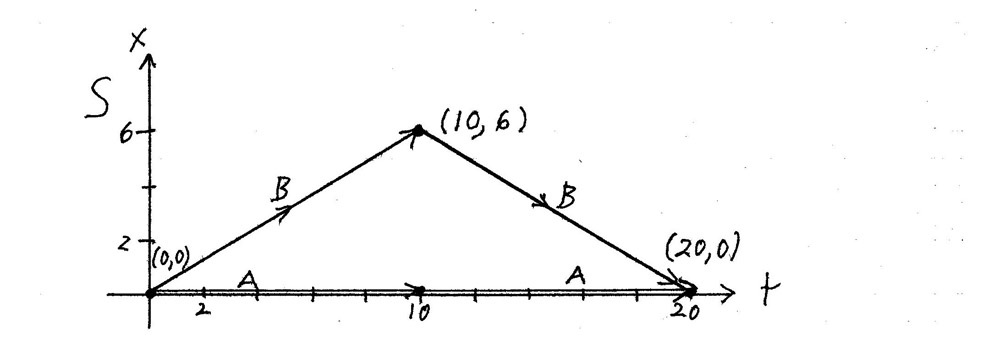
Not surprising we get a symmetric image of straight lines corresponding to Andy being at rest in S and Beatrice's outbound and homebound travels done with constant speed, the slopes of the lines giving the velocity (speed with sign), for example for Beatrice:
vB-out = (6 - 0) / (10 - 0) = 0.6 c and vB-home = (0 - 6) / (20 - 10) = - 0.6 c.
Beatrice's outbound journey in S-time lasts 10 years, her homebound journey the same, in total 20 years.
The graphs showing Andy's and Beatrice's world-lines in S' look like this:
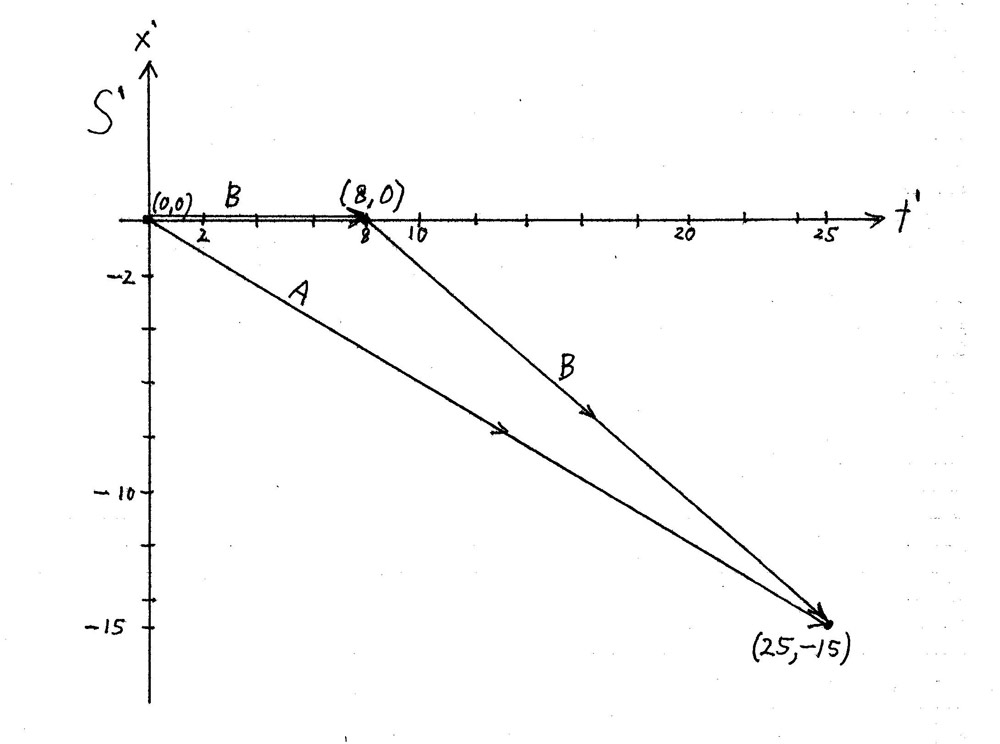
These worldline-graphs clearly reveals the asymmetry of the problem. Let us enterpret the situation.
In S' Andy is moving in the negative direction of the x'-axis with constant velocity:
v'A = (-15 - 0) / (25 - 0) = - 0.6 c.
In S' Beatrice is at rest in a period corresponding to her outbound journey in S (let us still call this her "outbound journey"), which in S'-time lasts 8 years. In that period she observes Arthur move away from her with the speed 0.6 c as just calculated.
Then Beatrice starts moving in the negative direction of the x'-axis with such a speed that she will catch up with Andy to reunite with him at (t', x') = (25,-15). Her constant velocity becomes:
v'B-home = (-15 - 0) / (25 - 8) = - 15/17 c = - 0.882 c.
The reunion of Beatrice and Arthur happens in S' after 25 years = 8 years for Beatrice's "outbound journey" + 17 years for her "homebound journey" or reunion with Arthur. But only the first 8 years are a proper time interval for Beatrice as it is only in this part of the journey she is at rest in S'. We must expect that the higher speed Beatrice must have to catch up with Andy results in a proper time much lower than the 17 years, - how low?
Let us find the proper time intervals for Arthur and Beatrice:
Arthur's total "travelling-time" in S' is 25 years and Arthur's speed is 0.6 c with γ = 1.25.
So the corresponding proper time for Arthur is then: 25/γ = 20 years.
This was as expected.
Beatrice's first 8 years are proper time for her, but her travel in the last 17 years is done with the speed 15/17 c.
The corresponding γ2 = 17/8 = 2.125 c.
So the corresponding proper time for Beatrice becomes: 17/γ2 = 8 years.
And the full journey takes 8 + 8 = 16 years in Beatrice' proper time.
So the conclusion is that when we look at the full trip from the point of view of Beatrice, analyzed via the inertial system S', we still get that her journey lasts 16 years in her proper time. There is actually no paradox here.
Remark: You could argue that the promise that we would analyze the Twin Paradox using only two inertial systems, S and S', is not quite fulfilled as we sort of hide the inertial system giving the proper time for Beatrice in the second half of the journey. This inertial system, S'', will be more visibly introduced in the following.
You can now or later study the *1. remark. |
|
|
Analysis using three inertial frames, S and S' and S''
We introduce an inertial system S'' moving with velocity v = - 0.6 c in relation to S (that is moving in the opposite direction than S') and (like S') with (0,0) of S'' passing (0,0) of S at the time t = t'' = 0.
We can use the Lorentz Transformations (1a) and (2a) substituting single dash ' with double-dash '' using v = -0.6, γ = 1.25.
Here is the table showing the events in S'':
S'' inertial frame
Events:
(t'', x'') |
Start at
Earth |
"Turning
point" |
End at
Earth |
| Andy (A) |
(0,0) |
(12.5, 7.5) |
(25, 15) |
| Beatrice (B) |
(0,0) |
(17, 15) |
(25, 15) |
Please, dear reader, transform all events from S to S'' to check this table.
You can now or later study the *2. remark
The graphs showing Andy's and Beatrice's world-lines in S'' look like this:
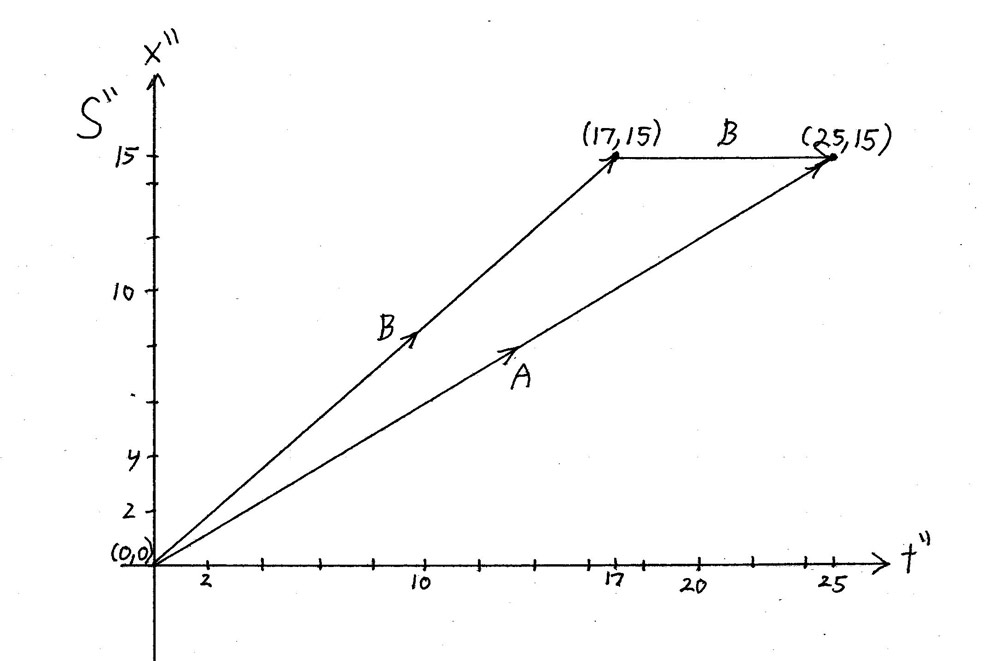
It is not surprising that this diagram in S'' looks very much like the corresponding diagram in S' - and we could make the same analysis in S'' as we did in S'.
But now we do something else. We analyze A's and B's journeys from start to "turning point" as seen from S' and then change to S'' and follow the journeys from "turning point" to the meeting at the end of the journeys.
| |
First part: S' (t', x') |
Second part: S'' (t'', x'') |
Events
|
Start at
Earth in S' |
"Turning
point" in S' |
"Turning
point" in S'' |
End at
Earth |
| Andy (A) |
(0,0) |
(12.5, -7.5) |
(12.5, 7.5) |
(25, 15) |
| Beatrice (B) |
(0,0) |
(8, 0) |
(17, 15) |
(25, 15) |
When jumping from S' to S'' we cannot expect that watches remain synchronized.
A's time does not change, t' = t'' = 12.5 at "turning point", but B's time change from t' = 8 to t'' = 17 at "turning point".
If we look at time-intervals for A and B in the two parts of their journeys we get:
Time intervals
|
First part:
S' Δt' |
Second part:
S'' Δt'' |
| Andy (A) |
12.5 - 0 = 12.5 |
25 - 12.5 = 12.5 |
| Beatrice (B) |
8 - 0 = 8 |
25 - 17 = 8 |
Finally let us find the proper time intervals. For A we must divide with γ = 1.25 (same in S' and S'').
The time intervals for B are already proper time intervals in S' and S'' respectively. So we get:
Proper time
intervals
|
First part:
S' Δt' |
Second part:
S'' Δt'' |
Total
proper time |
| Andy (A) |
12.5/ γ = 10 |
12.5/ γ = 10 |
20 |
| Beatrice (B) |
8 |
8 |
16 |
The resulting total travelling proper times are again the same as we got in the former analyzes.
|
|
|
Further remarks and considerations
*1. The "turning point".
Look again at the table showing events in S'.
How to enterpret (- and how not to enterpret) the space-time event for Andy named "Turning point", (t', x') = (12.5,-7.5)?
Well, actually this space-time event is just the Lorentz transform of the space-time event for Andy in S, (t, x) = (10,0) to S' - and as such not very interesting, neither for Andy nor for Beatrice. The reason for this is:
Allthough the "turning point" events as seen from S for Andy (10,0) and for Beatrice (10,6) are simultaneous events in S, their transform to S' are not simultanous events - Andy's time being t' = 12.5 and Beatrice' time being t' = 8.
Simultaneity is not conserved during a Lorentz transformation.
For Beatrice it would be more relevant to ask: Where is Andy as seen from S' at the time 8, which is simultanous with my arrival to the turning point as seen from my system S'?
We can solve this by calculating Andy's position in S' at the time 8 (see the graphs showing Andy's and Beatrice's world-lines in S' above). We can use that Andy's graph is a straight line with slope - 0.6 (as found when calculating v'A above).
Andy's position in S' at time 8 becomes: 0 - 0.6 * 8 = - 4.8.
So Andy's space-time event simultanous with Beatrice being at the turning point becomes in S': (t', x') = (8, -4.8),
Andy has moved away 4.8 lightyears (in negative direction) from Beatrice when she is at the turning point.
(This event is also the point for which the distance between A and B is maximal as seen from S', compare with the graph).
Let us find the Lorentz transform of (t', x') = (8, -4.8) in S' to Andy's system S.
Using the reverse Lorentz transforms we get:
x = γ (x + v/c ct) = 1.25 * (-4.8 + 0.6 * 8) = 0.
ct' = γ (ct + v/c x) = 1.25 * (8 + 0.6 * (-4.8)) = 6.4.
So (8, -4.8) in S' transforms to (6.4, 0) in S.
If Beatrice asks: How much proper time did Andy spend travelling while she travelled 8 years?, the answer is 6.4 years - which of course also could have been calculated simply as 8/γ = 6.4 years.
But, be aware that in the inertial system S Andy's (t, x) = (6.4, 0) is not simultanous with Beatrice arriving at the turning point (t, x) = (10, 6).
The calculation of these space-time events could also have been found using "mixed" Lorentz transforms,
knowing t' = 8 and x = 0, and finding t = 6.4 and x' = -4.8.
The reader is welcome to check this.
*2. Transformation directly from S' to S''.
In the table showing the events in S'' you were asked to check the coordinates in S'' as transformed from S.
You could also get the coordinates of these events by transforming from S' to S''.
The velocity of S'' as seen from S' can be calculated from the Lorentz transformation of velocities.
Show that this velocity becomes -15/17 c so that γ21 = 17/8 = 2.125 c.
Find from this the coordinates of the events in S''.
|
|
|
References:
Leo Sartori: "Understanding Relativity: A Simplified Approach to Einstein's Theories", University of California Press 1996.
Edward Harrison: "Cosmology. The Science of the Universe", second edition, Cambridge University Press 2000.
|