Alpha
Decay
Nuclear decay
by emission of an alpha particle (= He-4 nucleus) |

|
Beta(-)
Decay
Nuclear decay by emission of a beta(-) particle (= electron),
accompanied by emission of an anti-electron-neutrino. |
 |
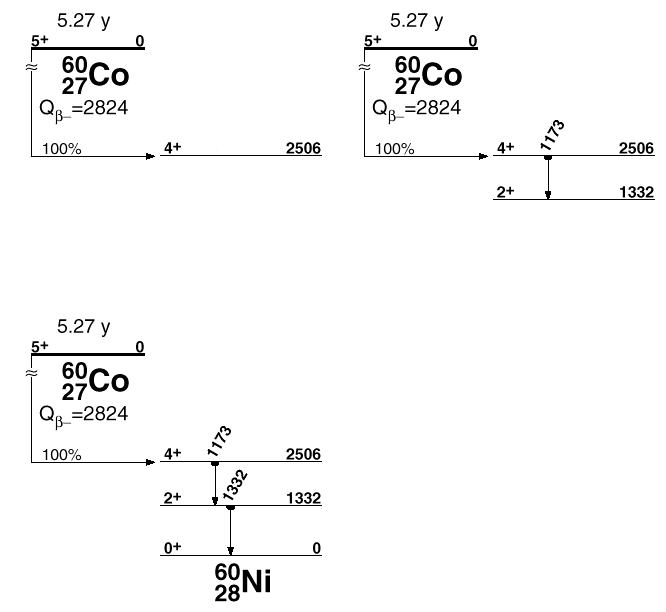
Gamma
Decay
Nuclear decay by emission of a gamma ray (= electromagnetic
radiation = photon). Gamma emission is a decay mode by
which excited state of a nucleus de-excite to lower (more
stable) state in the same nucleus. |
 |
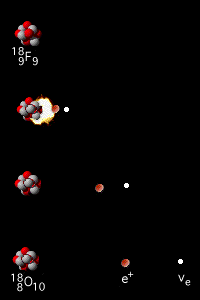
Beta(+)
Decay
Nuclear decay by emission of a beta(+) particle (= anti-electron
= positron), accompanied by emission of an electron-neutrino.
Positron decay is always accompanied by electron capture
decay. |
 |
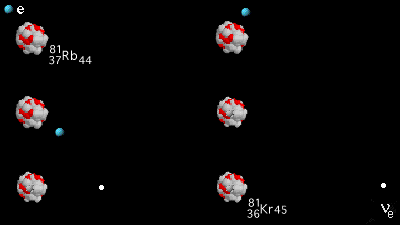
Electron
Capture Decay
Nuclear decay by capture of an atomic electron. If the
decay energy is greater than 1022 keV, positron emission
can also occur in competition with electron capture. |
 |
Beta-Delayed
Neutron Emission
When a large amount of decay energy is available, the
nucleus following the beta decay may emit neutrons, protons
or alpha particles. |
 |
Proton
Decay
Nuclear decay by emission of a proton. |
 |
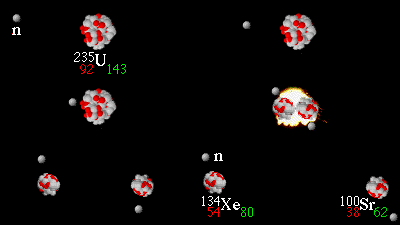
Neutron-Induced
Fission
Bombardment with a neutron resulting in splitting
the nucleus into two parts (fission fragments), neutrons,
and gamma rays. |
 |
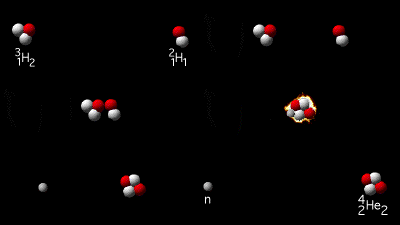
Fusion
Example: Fusion of deuterium (H-2) and tritium
(H-3) forming an alpha-particle (He-4). |
 |
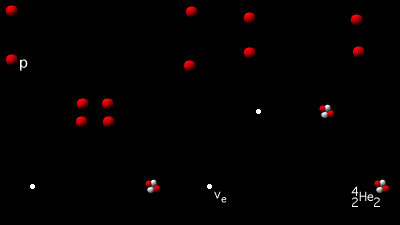
Hydrogen
Burning
Hydrogen burning is the fusion of four hydrogen nuclei
(protons) into a single helium nucleus (two protons and
neutrons.) The process is a series of reactions. The type
of reactions depend on the mass of a star and its core
temperature and density. In our Sun, the process is a
proton-proton chain. |
 |
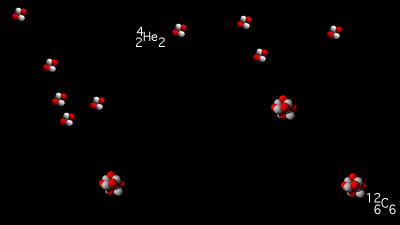
Helium
Burning (triple alpha process)
When temperature in the core of a star reaches 100 million
degrees, three colliding helium nuclei fuse to form a
carbon nucleus. This process occurs when the star is a
red giant. |
 |
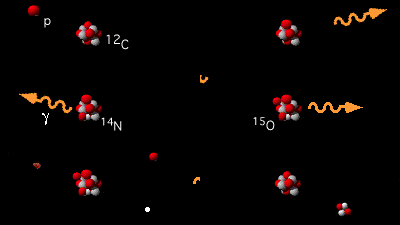
Carbon-Nitrogen-Oxygen
Cycle
In stars more massive than the sun (>1.1 Solar masses),
this cycle is the primary process which converts hydrogen
into helium. C-12 serves as a catalyst, an ingredient
which is necessary for the reaction but is not consumed.
|
 |
Photoelektrisk
effekt
Collision process between an x-ray or gamma rays and a
bound atomic electron where the photon disappears, the
bound electron is ejected, and the incident energy is
shared between the ejected electron and the remaining
atom. The photon energy must be greater than the atomic
binding energy. |
 |
Compton
Scattering
Collision process between a gamma ray and a bound atomic
electron where only part of the gamma-ray energy is transferred
to the electron.
|
 |
Pair
Production
A collision process for gamma rays with energies greater
than 1022-keV (two electron masses) where an electron
/positron pair is produced. A heavy nucleus must be present
for pair production. |
 |
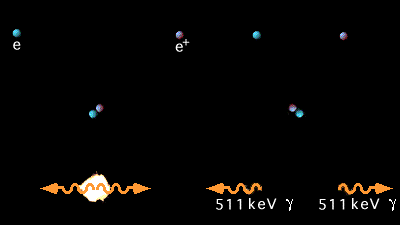
Elektron-positron
annihilation
Positron decay in matter by annihilation with an electron.
Usually and "atom" of positronium (e+e-) forms
which annihilates to produce two 511-keV photons. Occasionally,
the positron will annihilate in flight to produce one
or more photons sharing the total rest mass and kinetic
energy of the positron and electron. |
 |